
The tragic Manchester Arena attack in May 2017 brought the security of public venues and events into sharp focus, prompting calls for changes in the law to improve security at large public events.
Eventually, the Terrorism (Protection of Premises) Act 2025 (the Act) received Royal Assent in April 2025 and is expected to come into force from April 2027 at the earliest. The Act is also known as Martyn’s Law, after Martyn Hett, one of the victims of the Manchester attack.
Its purpose is to improve protective security and organisational preparedness across the UK by:
- Requiring organisations which are responsible for certain premises and events to consider how they would respond to a terrorist attack; and
- At certain larger premises and events, requiring those responsible to consider taking appropriate steps to reduce vulnerability to terrorist attacks.
Until the Act comes into force, there is no legal requirement to comply with it, but we would recommend familiarising yourself with its requirements and considering how to prepare for it as a matter of best practice.
What does Martyn’s Law do?
Martyn’s Law requires organisations which manage public venues and/or hold large events to put security measures in place to protect the public from the threat of terrorism.
In particular, it introduces a tiered system where the required security measures depend on the characteristics of the venue in question and the number of expected attendees.
The two tiers of requirements are as follows:
- a. Standard tier requirements – These rules typically apply to smaller premises, such as shops and restaurants, where 200-799 people are expected to be present. Requirements include ensuring that evacuation procedures and routes are in place, and that staff know how to implement a lockdown in the premises and communicate with customers / attendees in the event of an attack.
- b. Enhanced tier requirements – These rules apply to larger premises and events, such as concerts and sports stadiums, where 800 or more people may be present. Here, more extensive measures need to be put in place to increase proactiveness in reducing vulnerability to acts of terrorism.
Such measures include monitoring the premises (e.g. by having CCTV and bag search policies), controlling the movement of individuals (e.g. through enhanced staff training), enhancing physical safety of the premises (e.g. through vehicle checks and hostile vehicle mitigation measures) and ensuring security of information of the premises. Compliance with these requirements must be documented, and all standard tier requirements also apply.
Statutory guidance setting out more detail on the standard and enhanced tier requirements can be found here.
Who will Martyn’s Law affect?
Any organisations – including charities – which manage premises or hold events at which more than 200 people can reasonably be expected to attend will need to consider the requirements of Martyn’s Law, and factor the need for preparedness into their event planning.
This will include charities that manage schools and universities, churches, galleries and museums, historic estates and other heritage sites, and any charities that hold events (such as conferences and fundraising events) hosting 200+ people.
You can use the flowchart below to determine whether your premises / event falls under the Act.
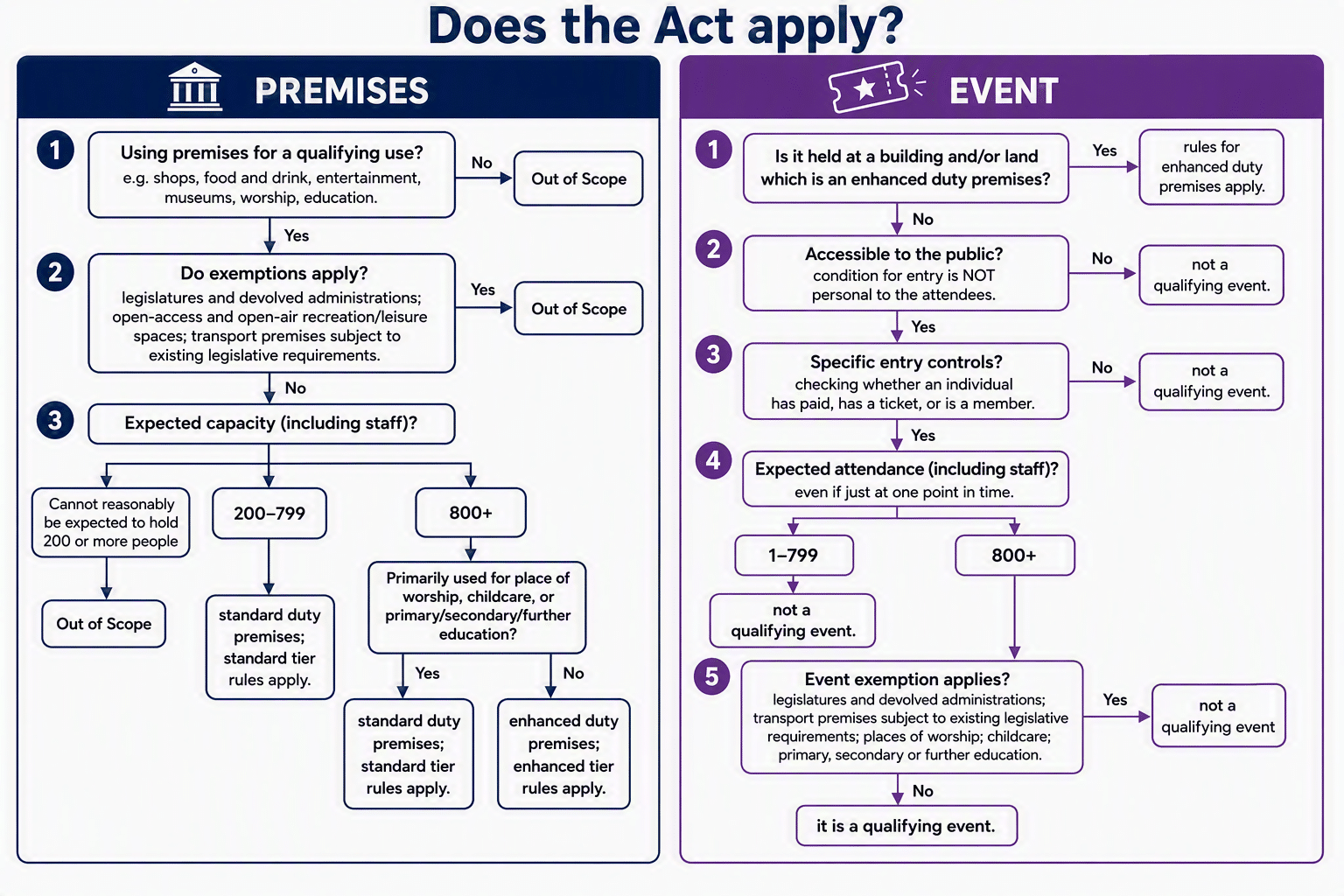
Please note that:
- Premises include a building, part of a building, or a building as well as other land.
- Qualifying uses (Schedule 1) include premises that are wholly or mainly used for shops, food and drink, entertainment and leisure, sports, libraries, museums and galleries (including outdoor exhibitions), halls (e.g. a conference centre), visitor attractions, hotels, places of worship, health care (e.g. a hospital), bus stations, railway stations, childcare, education including primary, secondary, further and higher education, and public authorities.
- Exemptions apply under Schedule 2 Part 1 if are your premises are one of the following:
- a. Legislatures and devolved administrations;
- b. Open-access and open-air spaces for recreational / leisure purposes (e.g. parks / gardens which do not require a ticket nor membership); or
- c. Transport premises subject to existing legislative requirements to consider and mitigate threats.
The SLCC has a useful tool to help you to understand whether Martyn’s Law applies to a specific event or a particular premises. This can be found here: https://www.slcc.co.uk/martyns-law/.
How should charity trustees and senior managers prepare for the new law?
Ahead of the Act coming into force in April 2027, we would recommend that charity trustees and senior managers take the following steps:
- Identify whether the Act applies to your charity, and if so, at what level (see part 3 above).
- Identify who the ‘responsible person’ is under the Act.
- The ‘responsible person’ is the individual, organisation or company that has control over the premises for the relevant use or qualifying event. For example, the responsible person of a retail shop is the company operating the shop, not the landowner.
- For enhanced tier premises and/or qualifying events: Where the responsible person is a company or organisation, a ‘senior individual’ must be appointed to ensure that the responsible person complies with the Act.
- The responsible person must notify the SIA when they become (or cease to be) responsible.
- Review your charity’s current security and evacuation procedures.
- Consider the terrorism risks that your premises and/or events might be most vulnerable to, taking into account their nature and characteristics.
- For example, schools could consider pick-up/drop-off times and when visitors might visit; churches could consider peak services times, weddings, events where more newcomers attend; and museums could consider visitor flow, bag storage and large temporary exhibitions.
- Prepare and implement internal policies that put the appropriate procedures and logistics in place for your charity’s circumstances. We would be happy to assist you in preparing these.
- Ensure that your charity’s staff and volunteers are sufficiently trained on the policies and procedures and can implement them effectively.
- Build compliance into your charity’s agreements with partners and third parties.
- For example, if your organisation lets out a venue for short-term events, you might need to communicate clearly with those hiring it about expectations of compliance with the Act and include that in your terms of letting.
- Keep records of your charity’s compliance with the Act. This should include an assessment of how these procedures reduce vulnerability and/or the risk of harm.
If you have any questions about the issues raised in this article, or you would like our assistance with preparing your charity for Martyn’s Law, please get in touch with Laura Sherratt or another member of our Blake Morgan Charities team.


Supporting charity trustees
Speak to one of our specialist charity lawyers
Arrange a callHow can we help?
To get in touch with one of our legal experts please fill in your details.

Explore more insights
 Events
 05 October
Preparing your charity for 2027: Martyn’s Law, governance and emerging risks
During this webinar, we will explore the impact of Martyn’s Law and the practical steps you can take…
 Articles
 21 September
Cybersecurity and data protection for charities
For many charities, a data breach can affect supporters, disrupt operations, damage trust and trigger regulatory reporting obligations.
 Articles
 29 July
New EHRC Code of Practice: Charities advised to take action
Charities are being urged to prepare for compliance with the EHRC Code of Practice, which comes into force…